
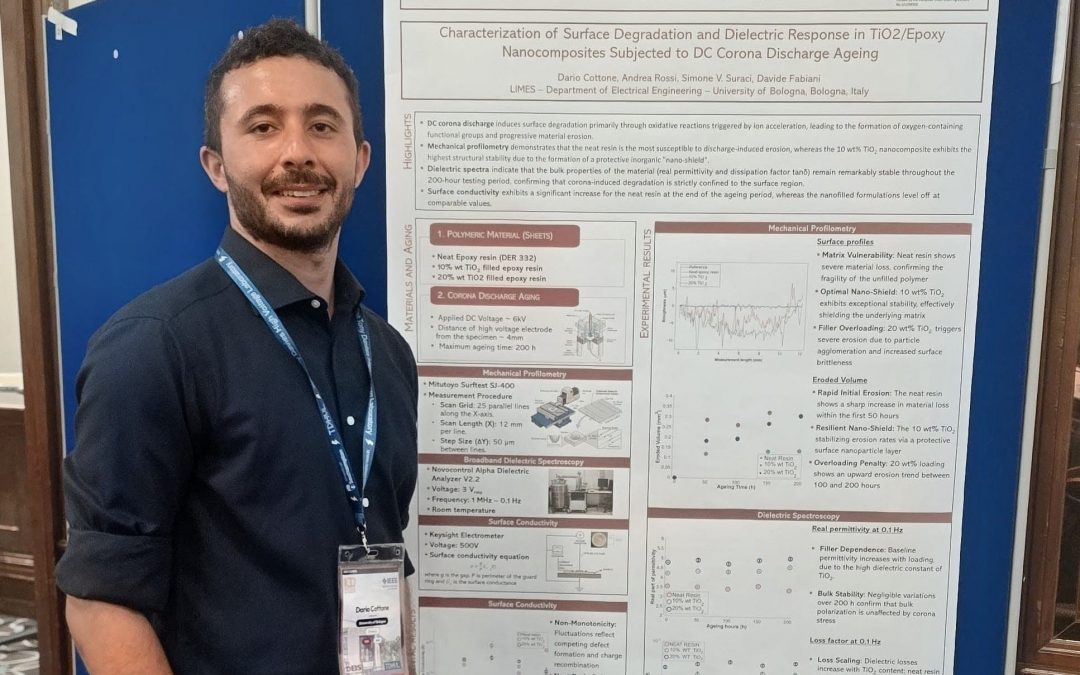
The IPROP project was recently represented at the International Conference on Dielectrics (ICD 2026), held in Southampton, United Kingdom, from 21 to 25 June 2026. The conference brought together leading international researchers working on dielectric materials, electrical insulation, and related high-voltage applications.
During the event, researchers from the Laboratory of Innovative Materials for Electrical Systems (LIMES), University of Bologna, presented recent results developed within the IPROP project, focusing on the behaviour of advanced insulating materials under electrical stress conditions relevant to atmospheric ionic propulsion systems.
The presented contribution, titled: “Characterization of Surface Degradation and Dielectric Response in TiO₂/Epoxy Nanocomposites Subjected to DC Corona Discharge Aging” investigates the performance and durability of epoxy-based insulating materials reinforced with titanium dioxide (TiO₂) nanoparticles when exposed to prolonged DC corona discharge.
This research is particularly relevant for next-generation electrohydrodynamic (EHD) propulsion systems, where dielectric components must operate reliably under high-voltage electrical stresses and harsh environmental conditions.
The study focused on three main aspects:
- Surface degradation mechanisms: analysis of erosion and morphological changes caused by continuous ion bombardment and plasma-induced oxidation.
- Dielectric property evolution: assessment of changes in surface conductivity and complex permittivity during accelerated aging conditions.
- Nanofiller optimisation: comparison of neat epoxy and TiO₂-loaded nanocomposites to evaluate how filler concentration influences resistance to electrical aging and insulation performance.
The study provides valuable insights into the design of more robust and reliable insulation systems. These findings support the development of materials capable of meeting the demanding requirements of future high-voltage atmospheric propulsion technologies.
Participation in ICD 2026 provided an important opportunity to engage with the international dielectric materials community, exchange knowledge, and discuss emerging challenges in high-voltage insulation systems.